News
Product accumulation at the end of the food packaging line


Product accumulation at the end of the food packaging line
In food packaging, the end-of-line stage is one of the most critical phases of the entire production process.
It is the point where packaged products must be managed, accumulated, and directed to subsequent operations without interrupting the production flow.
Inefficient product accumulation at the end of the line can cause slowdowns, machine stoppages, and increased waste, directly affecting plant productivity.
What is the end-of-line in food packaging
The end-of-line includes all operations following primary packaging:
-
Product exit from the packaging machine
-
Temporary accumulation
-
Quality control
-
Cartoning or palletizing
At this stage, upstream and downstream machine speeds are not always perfectly synchronized.
For this reason, it is essential to implement accumulation systems capable of compensating for differences in production rhythm.
Why bottlenecks occur at the end of the line
Bottlenecks occur when product handling capacity is not adequate for the output volume of the packaging line.
Main causes include:
-
Different speeds between packaging machines and downstream operators
-
Temporary stops for format changes or inspections
-
Insufficient space for orderly product accumulation
-
Delicate products requiring controlled handling
Without a proper accumulation system, these factors can lead to a complete line shutdown.
Solutions for product accumulation in food packaging
There are several technical solutions for managing product accumulation at the end of the line.
The choice depends on product type, line speed, and available space.
Conveyor belts
Conveyor belts allow linear product accumulation and are suitable when lengthwise space is available.
They ensure continuous flow management but offer limited accumulation capacity.
Rotary tables
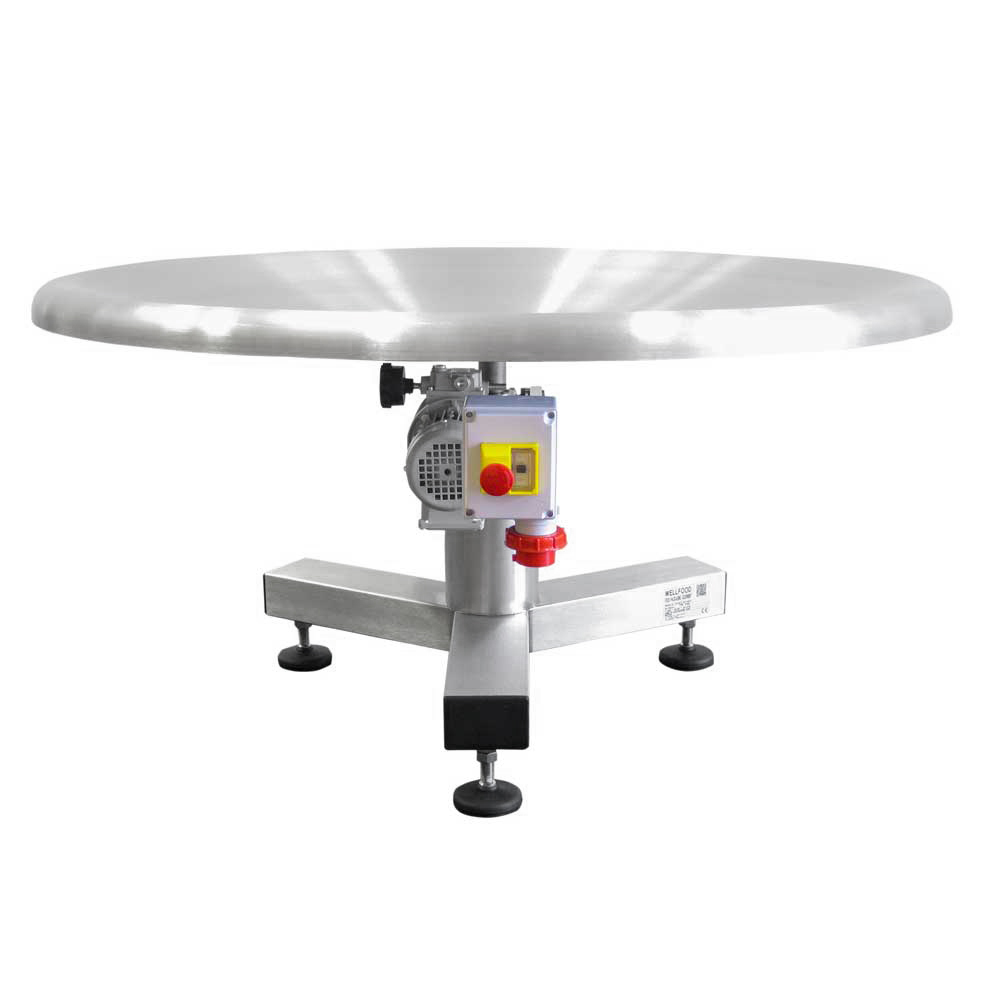
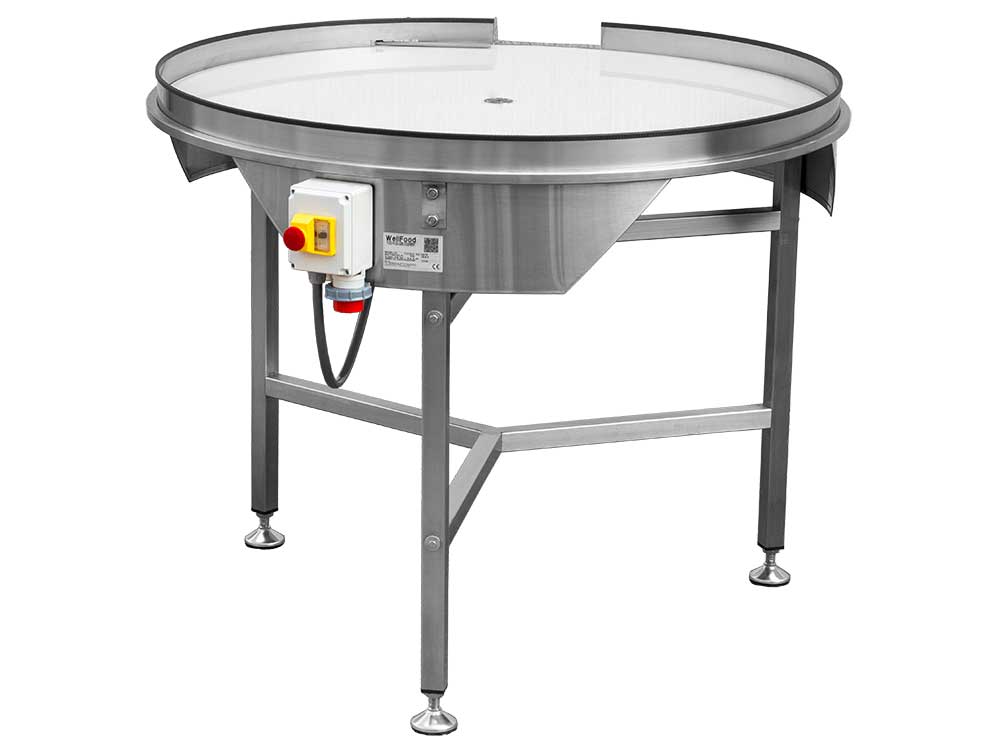
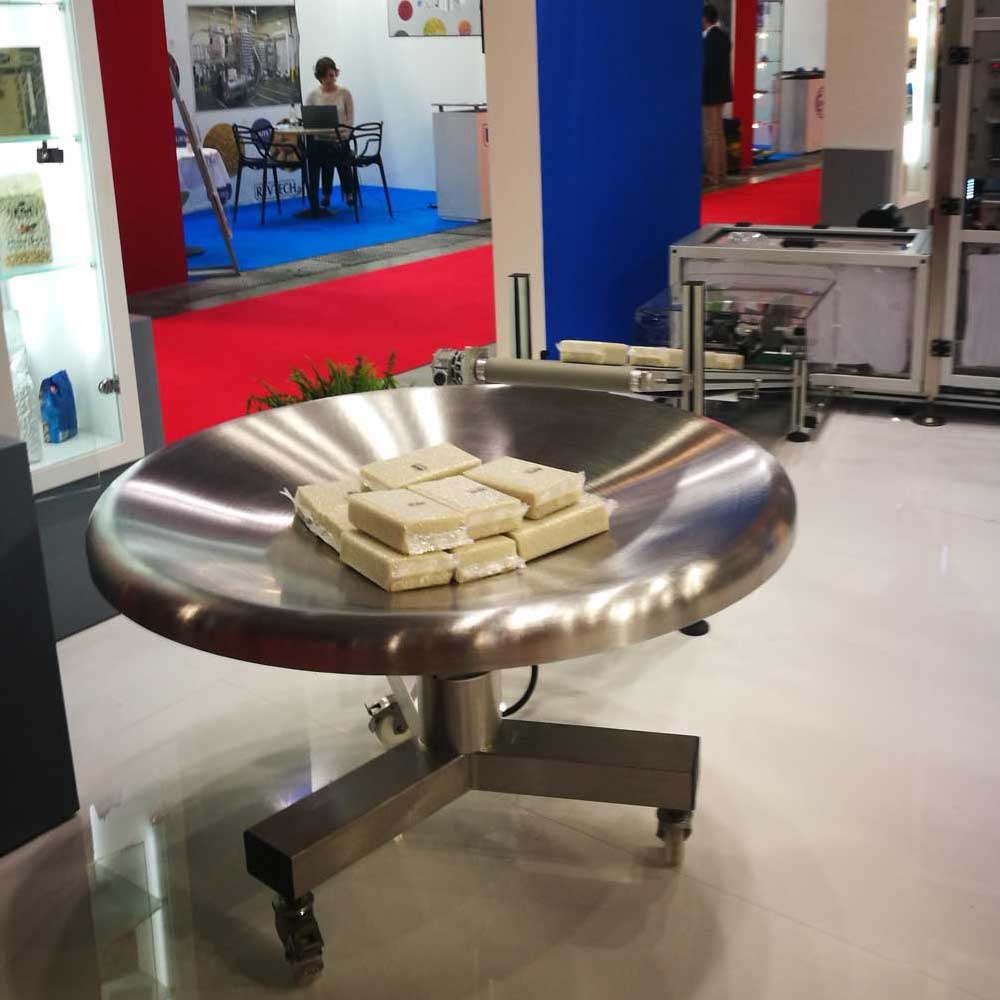
Rotary tables are among the most common solutions in food packaging.
They allow products to accumulate neatly on a circular surface, reducing footprint and ensuring continuous flow.
Stainless steel rotary tables are particularly suitable for the food sector thanks to their ease of cleaning and compliance with hygiene regulations.
Automatic accumulation systems
For high-speed or fully automated lines, more advanced accumulation systems are available, integrating sensors, electronic controls, and advanced management logic.
When to choose a stainless steel rotary table
A rotary table is the ideal solution when it is necessary to:
-
Compensate for speed differences between machines
-
Accumulate products without stopping the line
-
Reduce end-of-line footprint
-
Ensure high hygiene standards in the food industry
In food packaging, stainless steel is essential to ensure durability, resistance, and ease of sanitation.
Types of rotary tables for food packaging
Rotary tables can be configured in different variants depending on production needs:
Frequently asked questions about end-of-line accumulation
What is product accumulation at the end of the line?
It is the temporary management of packaged products exiting the line, necessary to maintain production continuity.
Why is the end-of-line so important in food packaging?
Because a blockage at this stage can stop the entire line, directly impacting productivity and costs.
Does a rotary table replace a conveyor belt?
Not always. The two solutions can be complementary depending on plant configuration.
Proper end-of-line design improves efficiency, reduces downtime, and optimizes the entire food packaging process.